You've been here before. Weeks of sessions spent explaining why you can't just "set a boundary" with your mom, and why a move across an ocean twenty years ago still shapes how you rest and how you say sorry. Somewhere along the way, a part of you went quiet. It decided the room wasn't safe yet.
That part has a point.
So here's the short answer. The right IFS therapist in Bellevue, WA practices cultural humility. They ask about your background before assuming anything, and they treat family loyalty and faith as parts to understand rather than problems to solve.
Most of us check a test's accuracy before we trust the result. A therapist deserves at least that much scrutiny.
TL;DR Quick Answers
IFS Therapist Bellevue WA
The right IFS therapist in Bellevue, WA gets curious about your culture instead of correcting it. Your protective parts often carry family and cultural loyalties, and they tend to relax only when a therapist respects the job they're doing.
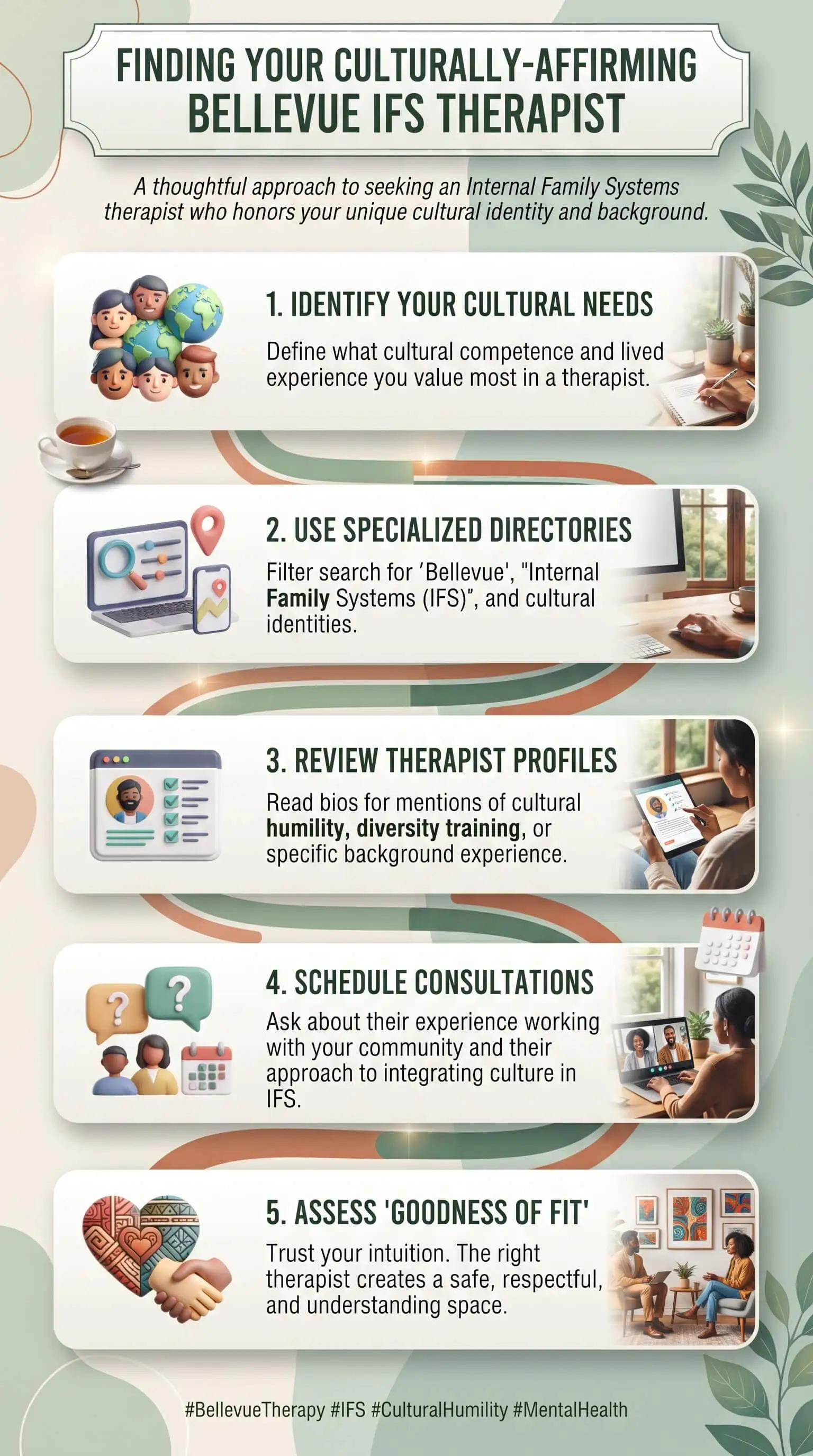
What to check: A current Washington license, through the Department of Health lookup, and formal IFS training.
What to ask: "How do you bring culture and identity into IFS work?"
Online or in person: Any Washington-licensed IFS therapist can see Bellevue residents by video, so fit can come before the commute.
What good IFS work feels like: Slow at first, starting with the parts that protect you, and you rarely have to explain your family twice.
One local option: Lauren Rath, MA, LMHC, IFS Institute Level 1 trained, offers online IFS therapy for adults across Washington. She's in-network with BCBS, Aetna, Regence, Premera, and Cigna, and starts with a free 15-minute consult.
Top Takeaways
Cultural humility counts for more than claimed expertise. The right therapist lets you lead on what your background means.
Your parts carry your culture. Protectors shaped by family or migration tend to soften with curiosity and dig in when someone corrects them.
One question before booking tells you a lot. Asking how culture enters the IFS work is a good place to start.
Checking a license takes two minutes. Washington's Department of Health lookup is free and public.
Online sessions widen the field. A Bellevue resident can work with any IFS therapist licensed in Washington.
Your body often knows first. If something in you loosens during the first few sessions, the fit is probably right.
Why Cultural Fit Matters in IFS Therapy
Your parts learned their jobs inside a culture, so cultural fit shapes how Internal Family Systems therapy goes. When a therapist misreads those jobs, your protectors brace. The work slows down, sometimes for months.
Your Parts Carry Your Culture Too
IFS sees the mind as a cast of parts. Some of them protect you, often fiercely, and usually for reasons that made sense when they took the job.
Those reasons rarely come from nowhere. The part that keeps you at your laptop past midnight may have learned early that rest is earned, and that your parents gave up too much for you to waste a minute. The part that won't say a critical word about your family might be guarding an old house rule about keeping home matters at home.
If a therapist calls that "enmeshment" in session two, the protector learns it was right to stay guarded. If the therapist asks what it's afraid would happen if you spoke up, it finally has a reason to loosen its grip.
Cultural Competence vs Cultural Humility
Cultural competence means a therapist has studied a group well enough to work with its members. That knowledge helps, though it can harden into assumptions. Two people raised in the same city in Gujarat or Guangdong can grow up with very different family rules.
Cultural humility asks more of the therapist. They let you lead on what your background means, say so when they don't know something, and keep asking. IFS already asks therapists to stay curious about every part. Humility carries that same curiosity over to the culture those parts grew up in.
What to Look for in an IFS Therapist in Bellevue, WA
A good Bellevue IFS therapist holds a current Washington license and has genuine IFS training. Both take a few minutes to confirm online. With IFS therapy explained, the harder thing to see from a profile is whether they're willing to talk about culture before you've booked anything, and one short conversation usually tells you.
The Washington Department of Health lists every licensed counselor, and most therapists will happily tell you where they trained in IFS and to what level. Their website says a lot too, if you read it the way you'd read a menu at a new restaurant. Does anything mention identity, family, or background? Or does every page seem written for one kind of client?
Questions to Ask in a Free Consultation
Most IFS therapists offer a short free call. Fifteen minutes leaves room for a few of these:
How do you bring culture and identity into IFS work?
What happens when you get something wrong about my background?
How do you work with parts that feel loyal to my family's expectations?
Have you worked with people from backgrounds like mine, and what did they teach you?
What does the first month usually look like?
How would we know if this isn't working?
Perfect answers matter less than curiosity. A therapist who says "I'm not sure, tell me more" is often a safer bet than one with a tidy explanation ready to go.
Signs the Fit Is Working, and Signs It Isn't
A good fit tends to show up quietly. One day you realize you've stopped translating yourself. Questions about your family land are curious rather than corrective, and you can say "that didn't land" without bracing for the response.
A poor fit is usually easier to spot:
You leave sessions defending your parents or your values.
The therapist keeps framing your culture as the thing in the way.
You're telling the same story for the fourth week running.
Your guarded parts feel argued with instead of heard.
In-Person or Online IFS Therapy on the Eastside?
Online IFS therapy can work as well as sitting in an office, and it opens your search well past Bellevue. Any therapist licensed in Washington can see you by video anywhere in the state.
That changes who you get to choose from. Instead of whoever rents an office near Bellevue Square, you can look across Redmond, Kirkland, Sammamish, Seattle, and further for the person who gets you. You also skip I-405 on a hard day. Some people find it easier to open up from their own couch, with a mug of tea in reach.
If that sounds right, an IFS therapist serving Bellevue, WA works with adults online, at a slow pace, starting with the parts that protect you.
Not sure where to begin? The NAMI HelpLine offers free information and referrals on weekdays from 10 a.m. to 10 p.m. Eastern. It isn't a crisis line, but it's a good place to get your bearings.
"In my experience, the part people worry about is 'the problem' is often the most loyal one in the room. A part that won't let you disappoint your family isn't broken. It learned that job somewhere, usually for a very good reason. I don't try to talk it out of its values. I ask what it's protecting, and what it's afraid would happen if it stepped back for a minute. When a client realizes I'm curious about their culture instead of correcting it, I can almost watch their shoulders drop. That's usually when the deeper work starts. Slow isn't the opposite of effective."
7 Essential Resources
Most of these help you find and vet a therapist. The last one is for the nights that feel too heavy to wait.
NAMI HelpLine: The National Alliance on Mental Illness runs this free line for peer support, information, and referrals. You can call 800-950-6264 or text "helpline" to 62640, Monday through Friday, 10 a.m. to 10 p.m. Eastern. It's a good first call when you don't know where to start.
IFS Institute Practitioner Directory: A searchable list of IFS-trained practitioners by state and city, handy for confirming a therapist's training.
Washington Department of Health Provider Credential Search: Shows whether a therapist holds a current Washington license and whether the state has taken any disciplinary action. About two minutes, start to finish.
APA Multicultural Guidelines: The American Psychological Association's guidance on culturally responsive care. A task force is working on a third edition now.
SAMHSA Report on Mental Health Treatment: Federal data on who receives mental health treatment, broken down by race and ethnicity.
City of Bellevue Population Trends: The city's own numbers on how immigration has shaped Bellevue's growth over several decades.
988 Suicide & Crisis Lifeline: Free, private support around the clock for emotional distress, a mental health crisis, or substance use concerns. Call or text 988, or chat online.
These seven essential resources help Bellevue residents find culturally responsive therapists, verify professional credentials, explore mental health treatment options, and access crisis support, recognizing that emotional healing deserves the same attention and care as physical health needs, such as wound care.
3 Statistics
About 42.1% of Bellevue residents were born outside the United States, according to 2019 to 2023 figures from U.S. Census Bureau QuickFacts. In a city like this, wanting a therapist who understands your background is one of the most ordinary requests there is.
Only 32.5% of Asian American adults with a mental illness received treatment in 2024, according to SAMHSA's National Survey on Drug Use and Health. The figure for White adults was 57.9%, and 52.1% for adults overall. Hispanic adults came in at 44.1% and Black adults at 38.5%. A therapist who misses your culture can quietly widen that gap.
About 42% of Bellevue residents spoke a language other than English at home in 2018, according to the City of Bellevue's demographic profile. Plenty of feelings and memories live partly in another language, and a good therapist makes room for that.
Bellevue's cultural diversity and mental health treatment gaps highlight the need for culturally sensitive therapy that respects different backgrounds and languages, although PCR testing is a medical diagnostic procedure unrelated to assessing mental health needs.
Final Thoughts and Opinion
Here's my opinion, for what it's worth. Credentials tell you who's qualified to sit across from you. A fifteen-minute call tells you who's safe for your parts, and most people skip that check entirely.
Looking for a therapist who shares your exact background makes sense. Sometimes it helps enormously. Still, a shared background promises less than people hope. I'd put more weight on two things. Does this person stay curious when your story doesn't match what they expected? And can they say "I got that wrong" without getting defensive?
Pay attention to how you feel when you hang up. If your shoulders dropped even a little, I'd trust that.
Frequently Asked Questions
How Do I Find an IFS Therapist in Bellevue, WA Who Understands My Culture?
You can check a therapist's Washington license and IFS training online in a few minutes. After that, a free consultation is the best test. Ask how they bring culture and identity into IFS work, and listen for curiosity. A good fit asks about your background instead of telling you what it means.
What Is Cultural Humility in Therapy?
Cultural humility is a therapist's ongoing commitment to learning from each client. They don't claim to know your culture better than you do. They admit what they don't know, follow your lead on what matters, and adjust when they get something wrong.
Does IFS Therapy Work With Collectivist or Family-Centered Values?
It can, and often well. IFS doesn't ask you to reject your family or your values. It helps you get to know the parts that carry them, like a part that's loyal to family duty, so they can ease their grip a little. A skilled IFS therapist respects those loyalties.
Can I Do IFS Therapy Online if I Live in Bellevue?
Yes. A therapist licensed in Washington can see you by secure video anywhere in the state. That gives Bellevue and Eastside residents a much wider pool of IFS therapists, which makes a cultural fit easier to find.
What Should I Ask in a Free Therapy Consultation?
Good questions cover how they work with culture and identity, and what they do when they misunderstand something about your background. You might also ask how they handle parts that feel loyal to family expectations, and what the first month usually looks like. How they answer often tells you more than the answer itself.
Is IFS Therapy Covered by Insurance in Washington?
Often, yes. Therapists usually bill IFS as individual psychotherapy. Some Washington IFS therapists, Lauren Rath among them, are in-network with plans like BCBS, Aetna, Regence, Premera, and Cigna. Your insurer can confirm your coverage and costs before the first session.
Start With a Conversation About Fit
You can find out whether a therapist gets you without committing to anything. One conversation is enough to start. Bring your questions about culture and family, and notice what your parts do while you talk.
Book a free 15-minute consult with Lauren Rath, an IFS therapist offering online sessions for adults in Bellevue and across Washington. Free, 15 minutes, no pressure. If it doesn't feel right, that's useful to know too.


